Thu Thiem Tunnel
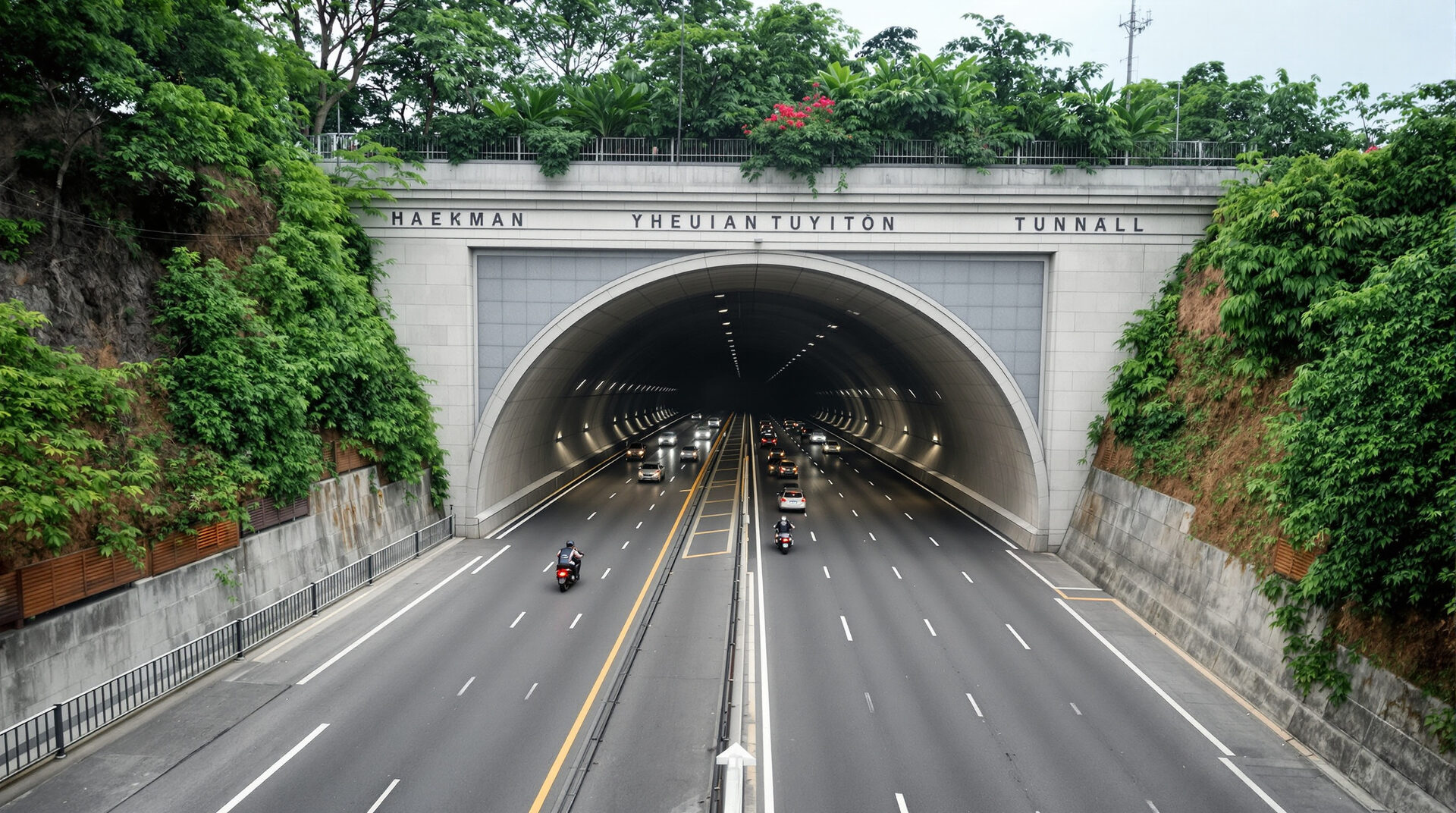
The 1.49-kilometre immersed-tube tunnel that opened in 2011 was the largest river tunnel in Southeast Asia at the time of completion, and the foundational piece of infrastructure that made Thu Thiem\'s development possible. Six lanes of traffic beneath the Saigon River, free to use, connecting the East-West Highway in District 1 to the central Thu Thiem peninsula.
- Type
- Immersed-tube tunnel
- Length
- 1.49 km
- Lanes
- 6 (2 × 3)
- Opened
- 20 November 2011
- Cost
- ~9,800 billion VND
- Connects
- East-West Highway ↔ Thu Thiem
- Largest in
- SE Asia at opening
- Daily traffic
- ~55,000 vehicles
The tunnel at a glance
The Thu Thiem Tunnel is a 1.49-kilometre immersed-tube tunnel beneath the Saigon River, carrying six lanes of traffic in two directions. The District 1 portal sits at the Vo Van Kiet (East-West Highway) terminus near the Khanh Hoi District 4 boundary; the Thu Thiem portal opens onto the Mai Chi Tho boulevard at the northern edge of the master plan. The tunnel is free to use for all permitted vehicle classes.
At its opening in November 2011 it was the largest river tunnel in Southeast Asia — a piece of infrastructure that announced Ho Chi Minh City\'s ambitions for the Thu Thiem peninsula as much as the master plan documents had. Without the tunnel, the Thu Thiem New Urban Area would not have been viable: it provides the bulk transport corridor that the entire master plan\'s connectivity strategy depends on.
Construction history and method
The Thu Thiem Tunnel was built using the immersed-tube method, well-suited to the Saigon River\'s soft alluvial geology and the practical constraints of a busy waterway. Four prefabricated reinforced-concrete tube sections, each 92.4 metres long, were cast in a dry dock at the Nha Be construction yard south of the city. Each section was floated into position over a pre-dredged trench in the riverbed, weighted and lowered into final position, joined to the adjacent section using rubber gaskets and steel connectors, and the trench backfilled with sand and rock.
Construction of the underwater portion took roughly four years (2007–2011), preceded by the East-West Highway corridor work and the dry-dock fabrication of the tubes. The contractor was the Japanese firm Obayashi, with Vietnamese consortium partners. Funding came predominantly from Japanese ODA loans through JICA, with a Vietnamese government counterpart contribution.
The official opening on 20 November 2011 was a landmark in Vietnamese infrastructure history. The total project cost — including the wider East-West Highway corridor — was approximately 9,800 billion VND.
Daily usage and traffic patterns
The tunnel carries roughly 55,000 vehicles per day in normal operating conditions, with the morning peak (7:00–9:00) and evening peak (17:00–19:00) producing the heaviest flows. Motorcycle use a dedicated lane within the carriageway; cars and trucks share the main lanes. Off-peak crossing time is typically 2–3 minutes; peak crossing time can reach 5–8 minutes during congestion events.
For Thu Thiem residents, the tunnel is the primary connection to District 4, southern District 1, and the wider western half of the city. Thu Thiem Bridge 2 handles the central District 1 connection more directly, but the tunnel remains the workhorse for southern and western trips.
Impact on the Thu Thiem story
The Thu Thiem Tunnel is the foundational piece of infrastructure for the entire new urban area. Three points worth making:
Without the tunnel, no Thu Thiem. Before 2011 the only access to the peninsula was a slow ferry from Quan 1 or a long detour via Bridge 1. No serious real-estate development was possible at the scale the master plan envisages. The tunnel\'s opening was the precondition for everything that has followed.
The tunnel anchors the wider arterial network. The East-West Highway corridor that the tunnel terminates into runs through District 1 across to Districts 5 and 6 in the west, and connects eastward via the Cat Lai port corridor to the Long Thanh expressway and onward to Dong Nai and Vung Tau. Thu Thiem\'s connectivity to the wider region — not just to District 1 — runs through the tunnel.
Tunnel durability is a long-term watch item. Saltwater intrusion and structural ageing have been issues for similar immersed-tube tunnels worldwide. Inspection and remediation programmes since the mid-2010s have addressed the most exposed sections of the Thu Thiem Tunnel; long-term maintenance budgets and inspection cadence are critical to keeping the asset in operational condition through its 100-year design life.
Related infrastructure
Thu Thiem Tunnel FAQs
What is the Thu Thiem Tunnel?
The Thu Thiem Tunnel is a 1.49-kilometre immersed-tube tunnel carrying six lanes of traffic beneath the Saigon River, connecting the East-West Highway (Vo Van Kiet Boulevard) in District 1 with the Thu Thiem peninsula. It opened to traffic on 20 November 2011 and was, at the time, the largest river tunnel in Southeast Asia.
How was the Thu Thiem Tunnel built?
The tunnel was built using the immersed-tube method: four prefabricated concrete tube sections, each 92.4 metres long, were cast in a dry dock at the Nha Be construction yard, floated into position over a pre-dredged trench in the riverbed, lowered, joined, and the trench backfilled. The technique allowed construction without disrupting river traffic and is well-suited to the soft alluvial geology beneath the Saigon River.
When did the Thu Thiem Tunnel open?
The Thu Thiem Tunnel opened to traffic on 20 November 2011, after a construction process that began in 2005 and was completed under the wider East-West Highway corridor programme. The official inauguration was a milestone event in Ho Chi Minh City's infrastructure history.
What does it cost to use the Thu Thiem Tunnel?
The Thu Thiem Tunnel is free for passenger vehicles and motorcycles to use. There is no toll. Operating costs are covered through the city budget.
What are the traffic restrictions in the Thu Thiem Tunnel?
Pedestrians, cyclists, and three-wheeled vehicles are not permitted in the tunnel. Hazardous-cargo vehicles are restricted under specific permit conditions. Motorcycles use a dedicated lane within the carriageway. Speed limit is 60 km/h for cars and 40 km/h for motorcycles.
What about flooding or saltwater intrusion?
The Thu Thiem Tunnel was engineered with multiple layers of waterproofing in the immersed-tube sections and has continuous monitoring for water ingress. Saltwater intrusion was identified as a long-term durability concern early in the operational life; remediation work in the late 2010s addressed the most-exposed sections. The tunnel is rated for a 100-year design life.